


 Twitter
How Classical Secret Sharing Works
The basic architecture of a secret sharing scheme has three elements: a “dealer,” who holds the original secret and is responsible for its distribution; a set of “players,” each of whom receives a distinct share; and a threshold defining the minimum coalition size required to reconstruct the secret. Any coalition of t or more players can collectively recover the secret by combining their shares. Any coalition of fewer than t players obtains no information whatsoever about the original secret.
This is formalized as a (t, n) threshold scheme: a secret is distributed among n players such that any t can reconstruct it but t − 1 cannot. The value of this construction lies in its simultaneous resistance to both external adversaries and internal collusion. Against external adversaries, compromising any individual player's share (or any coalition smaller than t) yields nothing. Against internal collusion or coercion, the requirement for coordinated action among a minimum number of players provides a deterrent as well as an operational control.
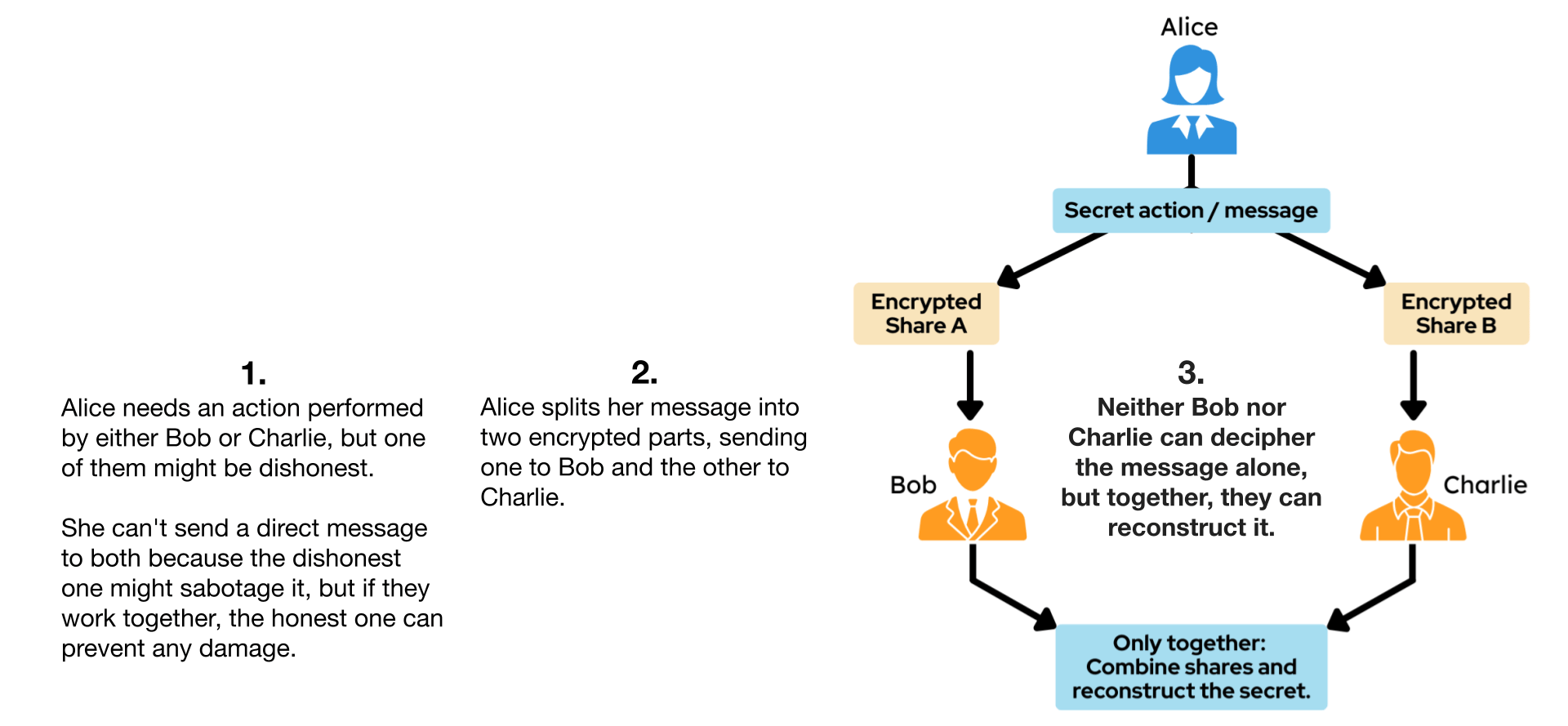
An everyday real-world example of secret sharing is its use in password managers and account recovery. Your master password is split into shares and stored across multiple servers or trusted devices. To recover your account, you need enough shares, such as from your phone, email, or trusted contacts. If one server is compromised, attackers cannot reconstruct your password. This protects access to email, banking, and work accounts every day.
A high-stakes use case for secret sharing is with nuclear launch codes. In some countries, the launch codes for nuclear weapons are split among multiple officials using threshold secret sharing. No single person can act alone, which prevents misuse or accidents. This is national security at the highest level.
How Quantum Secret Sharing Works
There are two essential approaches to incorporating quantum security into secret sharing: quantum-enhanced classical secret sharing and quantum secret sharing.
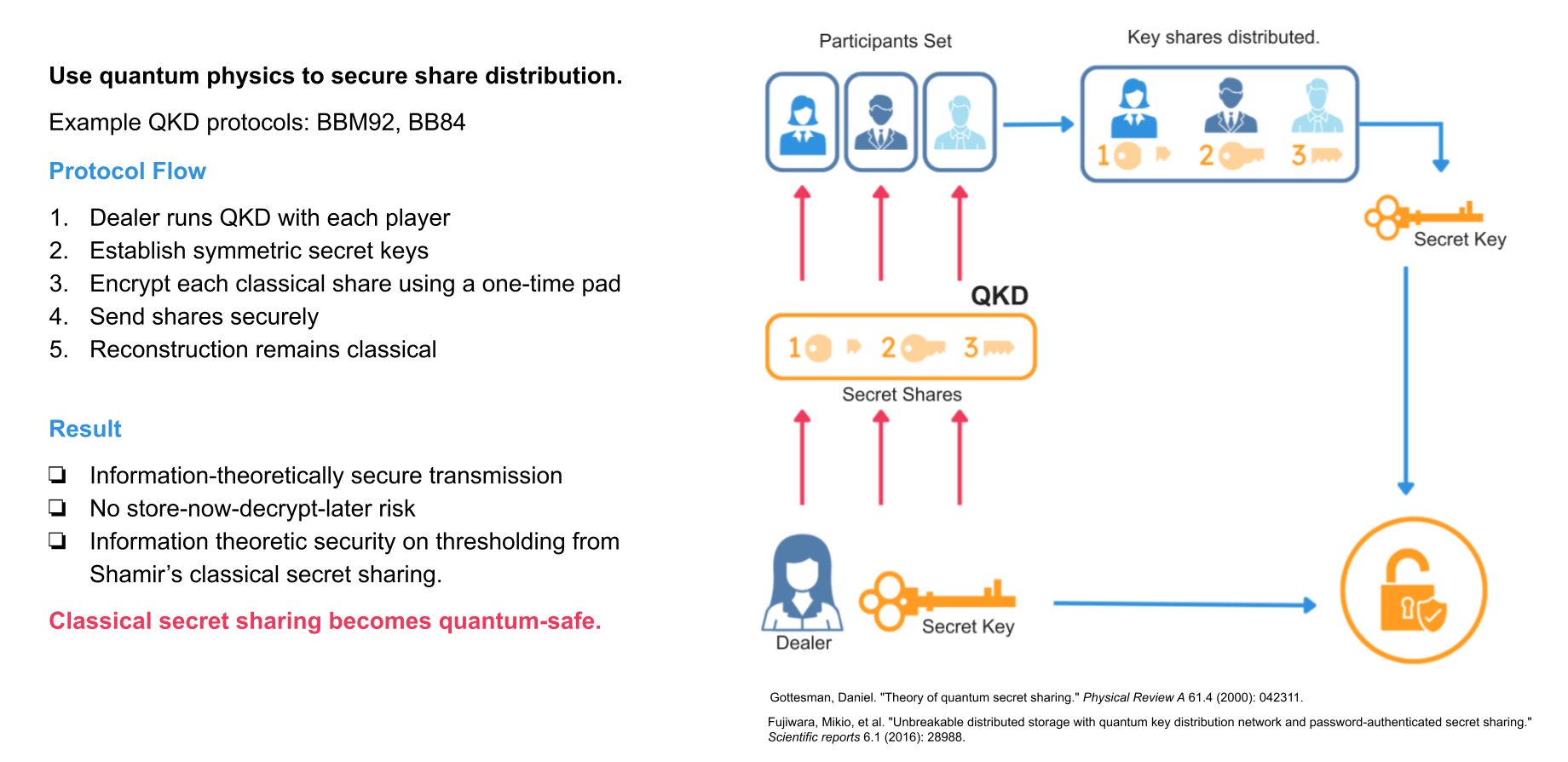
In quantum-enhanced secret sharing, each share of a secret key during transmission from dealer to the players, is protected by Quantum Key Distribution (QKD), which is secured by the laws of physics, not from the computational complexity of a mathematical problem. When shares are encrypted under a QKD-derived one-time pad, the transmission achieves information-theoretic security.
This approach preserves the classical threshold reconstruction logic entirely. The dealer distributes shares using quantum-secured channels; once the players receive the shares, they reconstruct the secret using standard classical operations. No quantum hardware is required at the reconstruction stage. The quantum-secure upgrade is confined to the distribution layer.
The formal concept of quantum secret sharing was introduced in a 1999 paper by Mark Hillery, Vladimír Bužek, and André Berthiaume, which proposed using entangled quantum states—rather than classical secret-sharing schemes based on random polynomials or random strings—as the mechanism for splitting and distributing secrets. The paper identified two main modes of quantum secret sharing— using quantum states to share either: classical secrets (unknown bit strings whose value must be hidden from sub-threshold coalitions) or quantum secrets (unknown quantum states whose full information cannot be extracted by any subset of players without collaboration). Both categories use QSS protocols, but their implementation requirements are very different.
For classical secrets, the motivation for using true QSS rather than quantum-enhanced classical sharing is that multipartite entanglement simultaneously provides both the threshold enforcement and the eavesdropper-detection property within a single protocol, without requiring the dealer to establish separate pairwise QKD sessions with every individual player.
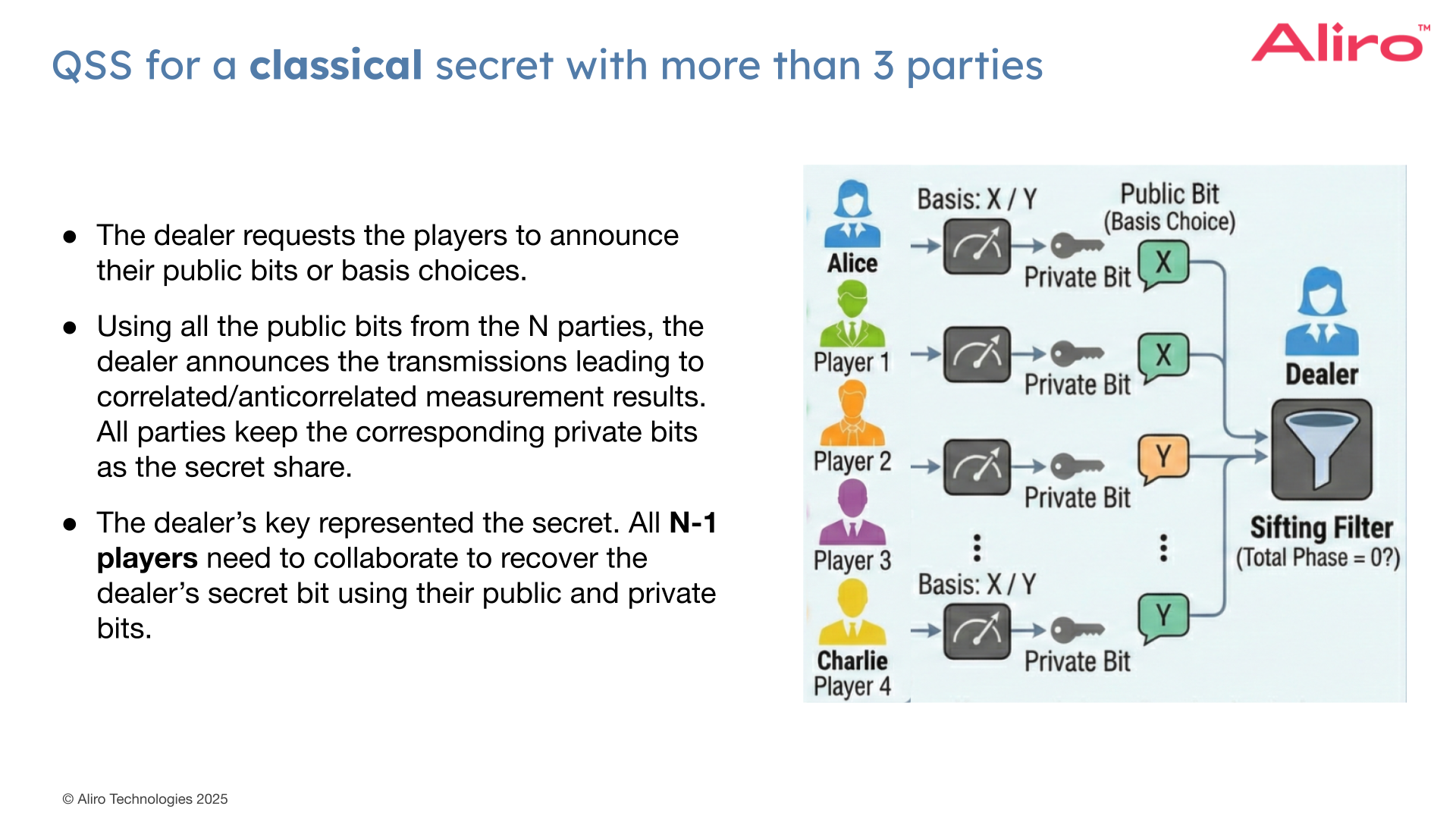
Practically, however, it is worth noting explicitly that pairwise QKD combined with classical threshold reconstruction whose reconstruction security is information-theoretic (such as Shamir’s secret sharing protocol) achieves the same security guarantees with substantially less demanding hardware requirements. True QSS for classical secrets represents a more elegant unified protocol but does not, at present, offer a decisive operational advantage over the hybrid approach for organizations beginning their quantum security journey.
On the other hand, quantum secrets are represented by unknown quantum states whose information content cannot be fully described classically or duplicated. The no-cloning theorem prohibits copying an unknown quantum state. When the secret itself is intrinsically quantum, true quantum secret sharing is not only necessary but also provides a more natural and secure approach for distributing the secret.
The protocol requires the distribution of multipartite entangled states, along with the capability to perform Bell-state measurements at the dealer’s node and controlled quantum gate operations on the shares held by the end-node players who collaborate to reconstruct the secret. This renders quantum secret sharing for quantum secrets more demanding in experiments than QSS for classical secrets.
For security teams evaluating near-term deployment options, it’s worth noting the practicalities of various quantum secret sharing protocols. For classical secrets, pairwise QKD with classical threshold reconstruction is a well-understood, incrementally deployable option that achieves both information-theoretic transmission security and information-theoretic threshold security. It also has lower hardware complexity than multipartite entanglement-based QSS. On the other hand, using multipartite entanglement for QSS offers an integrated protocol and, in future many-party quantum networks where multipartite entangled state distribution is a native capability, the secret sharing becomes more simple operationally.