


Aliro Simulator
Real-world accuracy for modeling entanglement and designing quantum networks.
The Aliro Simulator platform provides a single environment for physics modeling and network planning.
Aliro Simulator has two distinct methodologies: Aliro Quantum Network Simulator (AQNSIM) and the Aliro Emulation API.
The Aliro Quantum Network Simulator (AQNSIM) predicts how a quantum network will behave, down to the picosecond.
The Aliro Emulation API reproduces that behavior in real time for the applications and devices that will depend on it.
In practice, that means users can:
- Estimate realistic rates, fidelity, latency, and robustness before deployment.
- Compare competing hardware modalities and vendors.
- Test protocol behavior and orchestration logic.
- Identify viable use cases on a proposed network.
- Reduce expenditures and integration risk before hardware purchase.
- Scale from link-level studies to large heterogeneous networks.
- Build an ROI-backed roadmap for pilot and deployment.
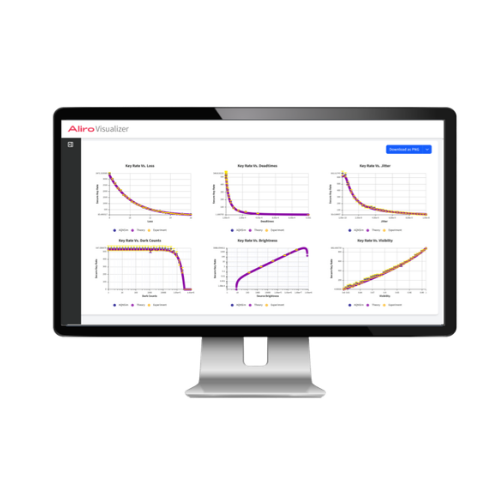
See Aliro Simulator in action:
We built AQNSIM to address the specific needs of quantum network design and validation.
Discrete event simulation.
Quantum networks are driven by timed events.
Timing-sensitive effects are frequently the determining factor in whether a protocol works at all. Aliro's picosecond accuracy for photon arrivals, clicks, and sync windows are modeled as timed events and validated against real timing.
Multiple state computation backends.
AQNSIM enables users to weigh different tradeoffs between parameters, such as fidelity and scalability.
Swap between Cirq, QSim, QuTiP, or your own accelerator. Pick the state representation each study needs, from a high-fidelity memory swap to a large heterogeneous, multi-vendor network.
Library of quantum and classical device components.
Real-world deployments are hybrid systems that integrate classical and quantum hardware.
AQNSIM features a library of generic quantum and classical devices: sources, detectors, fiber, wave plates, beam splitters, memories, switches. Swap devices, compare vendors, and model hybrid multi-vendor networks without rewriting the model.
Noise models.
Loss, decoherence, drift, and timing misalignment all impact the performance of the quantum network. AQNSIM incorporates the how daylight, temperature, polarization drift, and moving nodes change output over the course of the day. More than 18 physical fiber parameters and real OTDR traces are available as input, so your route is modeled accurately.
Design, test & optimize at scale.
Explore and compare quantum network designs, identify optimal configurations, and accelerate testing with automated simulations and cloud computing.
Code & no-code workflows.
A full Python API exists alongside no-code simulation workflows in the Aliro Simulator web app.
Setup, execute, and visualize simulations so physicists, network engineers, and program leads work from the same model.
The Aliro Emulation API allows users to test how a quantum network would actually behave under simulated operating conditions before investing in physical hardware.
Real-time quantum network emulation.
Reproduce realistic quantum key distribution behavior in real time, allowing connected systems to process data as network conditions change. Unlike virtual-time simulation, it enables connected systems to respond to changing network conditions as they occur.
Three levels of emulation in one API.
Level 1: Secret Key Emulation. Uses channel conditions and error correction/privacy amplification (EC/PA) settings to generate finished secret keys. For teams testing applications or encryption systems that need finished quantum-derived keys.
Level 2: Raw Key Emulation. Uses channel conditions and measurement distributions to generate raw key bits for further processing. For teams developing and testing key sifting, error correction, and other post-processing functions.
Level 3: Detector Data Emulation. Uses channel conditions and hardware specifications to generate realistic photon detection timestamps. For teams testing lower-level systems that process individual photon detection events.
Use with existing systems to predict performance.
The Aliro Emulation API delivers realistic data to physical or emulated encryptors, key management systems, controllers, and applications. Connecting the Aliro Emulation API to external systems allows teams to test how the existing classical infrastructure will interact with the emulated quantum network, before any quantum hardware is even purchased.
Realistic network conditions.
Model factors such as transmission distance, channel efficiency, detector performance, background noise, and timing variations. Key rates and quantum bit error rates (QBER) are recalculated as channel parameters change, helping teams understand their effects on downstream systems.
Concurrent emulation sessions and parallel processing.
Test complex networks with multiple simultaneous sessions.
The Aliro Emulation API supports concurrent emulation sessions and parallel processing for large-scale testing.
Beyond QKD.
Lossy, time-independent quantum systems such as secret sharing and position verification; standard interfaces (e.g. ETSI key delivery) can be built around the server
Three ways to use the Aliro Simulator platform
Code locally.
Install the AQNSIM Python framework on your own machine and use the full API to build devices, protocols, and analyses, with local execution for development and small studies.
Cloud API
Submit the same code to Aliro's cloud: parameter scans and batches run in parallel, GPU acceleration is a flag away, and every step is persisted and retryable on failure.
Aliro Simulator Web App
Set up, run, and analyze simulations in your browser. Use a Quantum Secure Communications template, set configurable parameters to model your unique conditions, run on Aliro's cloud, and plot key rate and QBER in-app. More templates coming soon!