


 Twitter
Quantum processors are steadily evolving from single monolithic QPU designs toward a model of a quantum data center linking many QPUs. A single monolithic QPU has practical limits set by fabrication yield, control wiring, cryogenic overhead, and calibration complexity. The quantum data center model is one plausible path to scaling, but it requires a networking architecture that can accommodate the challenging reality of interconnecting QPUs: different QPU platforms “speak” very different languages. Different QPU platforms may operate at different control frequencies, use different interfaces for generating photons, and naturally align with different photonic encodings. A practical quantum network must bridge the diversity of these QPUs in a way that is compatible with photonic infrastructure.
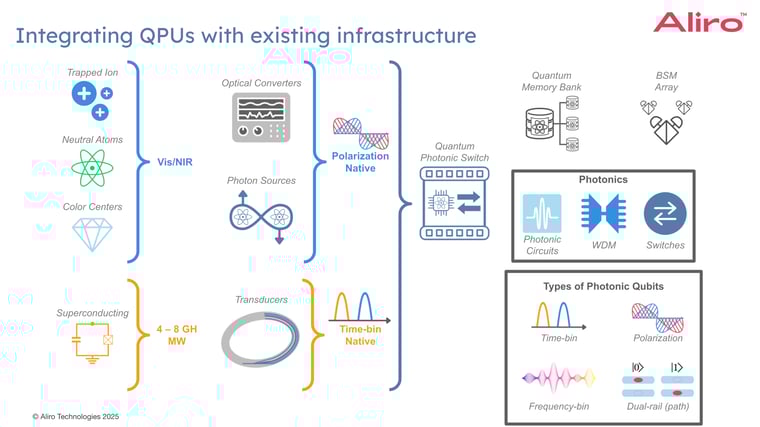
Most concepts for interconnecting QPUs rely on photons. Photons propagate well, can be routed, multiplexed, and switched, and they align with decades of development in telecom fiber and integrated photonics. However, QPUs do not all generate or absorb photons in the same way. At the hardware level, QPUs span very different electromagnetic regimes. For example, superconducting qubits are manipulated using microwave signals (often in the 4 to 8 GHz range). Trapped ions, neutral atoms, and color centers, interact with light in the visible and near-infrared range.
To bridge these regimes, each QPU will require a quantum network interface, or quantum interconnect, that couples stationary qubits in a processor or memory to flying qubits in the network.The implementations vary depending on the platform, but most quantum network interfaces / interconnects utilize the same set of functional components:
Transducers. For superconducting QPUs, it can be challenging to convert the fragile quantum states between microwave and optical frequencies. This is an active research area today. In a data-center setting, the performance requirements are set not only by whether the conversion works, but also whether it’s fast enough, its noise can be kept low enough, and its efficiency kept high enough to support network protocols. Some conversion and routing approaches more naturally preserve certain photonic encodings.
Optical frequency converters. For matter-based platforms that already operate in Vis/NIR, the interface problem is often closer to optical frequencies, but still nontrivial. Many atomic and solid-state emitters produce photons in the visible or near-infrared that are not in the standard low-loss telecom windows. A frequency converter can be used to translate a photon’s wavelength between wavelengths (for example, from a platform’s native optical transition toward telecom-friendly wavelengths) while preserving the quantum state.
Photon sources and entangled-pair generation. A quantum network connecting QPUs requires a mechanism for generating entanglement between nodes (QPUs). One common approach is interference-based entanglement generation, where photons come from remote nodes, while another approach uses dedicated entangled photon sources that distribute photons to remote nodes. Centralized sources can simplify node requirements, however node-local generation can reduce dependence on shared components. Both approaches require tight control of photon indistinguishability.
Photonic qubit encodings. Photonic qubits are not a single format. The schematic explicitly lists time-bin, polarization, frequency-bin, and dual-rail (path) encodings. Each has practical consequences. Certain QPU interfaces and link technologies naturally favor particular encodings. A practical quantum interconnect for QPUs must be designed with compatibility and interoperability in mind.
The quantum network fabric is the shared “plumbing” that lets a multi-QPU system operate like a single coordinated system:
- Signal-handling components create, shape, and maintain stability of quantum signals.
- Methods for using shared links efficiently, such as resource optimization and multiplexing.
- Switching and routing functions that direct quantum signals to the correct destination at the right times.
- Quantum memories to buffer quantum states for synchronization, scheduling, and remote protocols
- Bell-state measurement (BSM) arrays that enable interference-based entanglement generation and support protocols like entanglement swapping and routing
Taken together, these elements point to a path for realistic integration of heterogeneous QPUs connected through photonic interfaces, unified by a quantum network fabric that can generate, route, buffer, and verify entanglement. This same path leverages existing infrastructure, especially optical components and networking concepts.
For more on how the path to scalable quantum computing is paved by networking, see our on-demand webinar Quantum Computer Networking: A Vision for the Future Quantum Data Center. In this webinar, we discuss:
- The diverse QPU platforms driving quantum computation.
- Interconnect technologies and network architectures that enable scalable, fault-tolerant systems.
- The use of NVIDIA’s NVQlink for interconnecting GPU supercomputers directly to QPUs.
- What is needed in a compiler, scheduler, and orchestrator.
- How QPUs integrate with HPC and cloud infrastructure for hybrid computing.