


 Twitter
In quantum networked systems,“qubits” may refer to a few layers of abstraction: from hardware-level physical qubits on a device to error-corrected logical qubits used by applications. Many different qubits play many different roles inside a QPU, and across a quantum network.
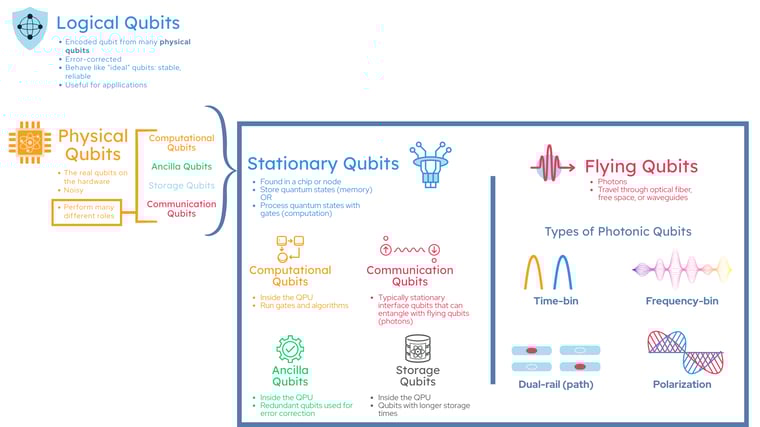
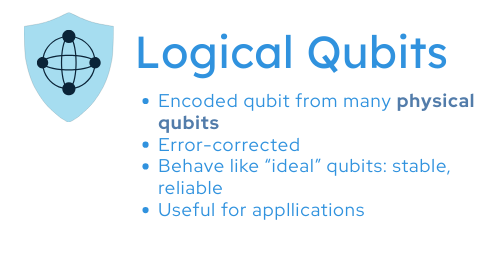
Logical qubits. Error-corrected qubits that encode information across many physical qubits using quantum error correction. This allows errors to be detected and fixed, making the logical qubit far more reliable than any single physical qubit. Quantum algorithms are written in terms of logical qubits, even though the hardware must use many physical qubits to implement them.
Physical qubits. The actual qubits on a QPU or other quantum device. Different qubit platforms use different physical systems, such as trapped ions, superconducting circuits, neutral atoms, or photonic qubits to store and manipulate quantum information. Depending on the platform and architecture, physical qubits can be specialized for different functions.
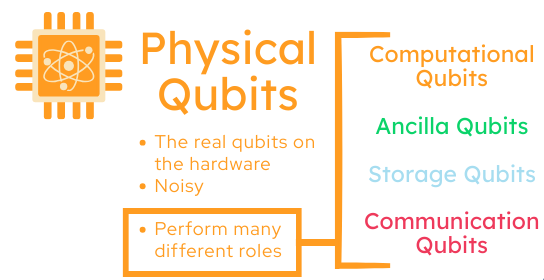
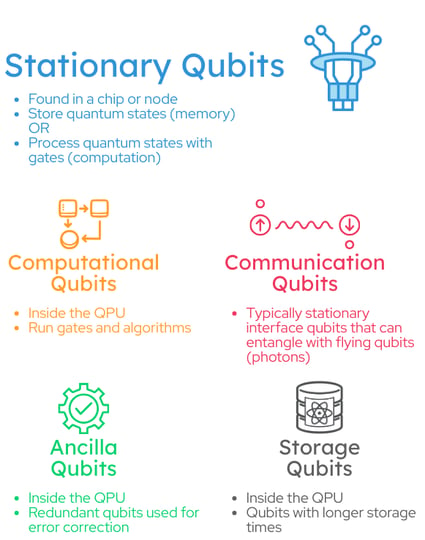
Computational, ancilla, storage, and communication describe the roles typically implemented through stationary physical qubits:
Computational qubits. Execute gates. Carry the algorithm’s quantum state during computation.
Ancilla qubits. Support measurement and error correction. Rather than directly measuring a computational qubit, which would collapse its state, ancilla qubits are used to extract error syndromes and other diagnostic information indirectly.
Storage qubits. Optimized for preserving quantum states longer or with lower cross-talk.
Communication qubits. Sometimes referred to as interface qubits. These qubits connect stationary qubits to flying qubits. They enable entanglement between qubits located in different quantum processing units (QPUs), forming the basis for distributed quantum computing. The design of this quantum interconnect between stationary and flying qubits is highly platform-dependent: a superconducting system can be quite different from a trapped-ion or neutral-atom implementation.
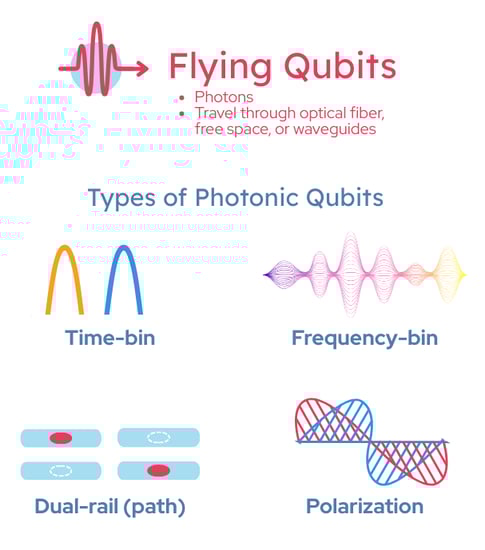
Flying qubits. Qubits that travel through a transmission channel, most often as photons moving through optical fiber or free space. These qubits are the backbone of quantum networking because photons can carry quantum information over long distances with relatively low decoherence compared to other qubit platforms. Just as importantly, photonic qubits are compatible with today’s optical networking infrastructure, making them a practical choice for real-world deployment. There are different ways to encode quantum states in flying qubits in the photonic regime. Photonic degrees of freedom, or dimensions, can be used to encode a quantum state, including:
- Time-bin encoding. The qubit is encoded in a superposition of the photon’s arrival-time modes (early vs. late).
- Polarization encoding. The qubit is encoded in the photon’s polarization (e.g., horizontal, vertical, diagonal, circular).
- Frequency-bin encoding. The qubit is encoded in discrete frequency modes.
- Spatial/path encoding. The qubit is encoded based on which optical path a photon takes, often manipulated using beam splitters and phase shifters.
These terms provide a useful shared vocabulary and hint at the complexity of networked quantum systems. They map the architecture of a networked quantum system. Some of these labels distinguish levels of abstraction (logical vs. physical), others define operational roles (computational, ancilla, storage, communication), and still other terms describe how quantum information propagates (stationary vs. flying).
A real-world quantum data center won’t use just one of these qubit types; it will integrate all of them. The future of scalable quantum computing depends on architectures and control stacks that unify computation and networking into a single, coordinated system.