

 Twitter
Why Timing Synchronization Matters in Quantum Networks
Entanglement-based quantum networking is a powerful technology that enables applications like Quantum Secure Communications (QSC), distributed quantum sensing, and the networking of quantum processors for greater computing capabilities.
There is a practical complication that every real deployment runs into: if two nodes can’t maintain sufficient timing alignment, they can’t reliably match detection events from the same entangled photon pair. When this happens, the end nodes are only left with accidental coincidences from background noise while the true coincidence events from entangled photon pairs are lost and this reduces the usable entanglement rate and fidelity, often to the point that entanglement-based applications become impractical.
Timing synchronization is a foundational, practical requirement that makes real-world entanglement-based applications possible.
Timing Synchronization in Entanglement-Based Networks
In an entanglement-based link, a source generates entangled photon pairs and sends one photon to each end node. Although these photon pairs travel different path lengths and arrive at different times, their detection times remain strongly correlated. By time-tagging events and aligning the two nodes’ time offsets (accounting for clock drift and path-delay variations), the system can identify true coincidences within a defined coincidence window.
Three practical approaches to timing synchronization
Timing synchronization is an evolving field, and new techniques continue to emerge. The images below show three different approaches:
- a White Rabbit precision time protocol,
- a classical sync pulse based on detection signal from one node time multiplexed with quantum signal routed to the other node, and
- GPS clocks and a coincidence histogram for timing drift compensation.
White Rabbit + optical clock distribution over the same fiber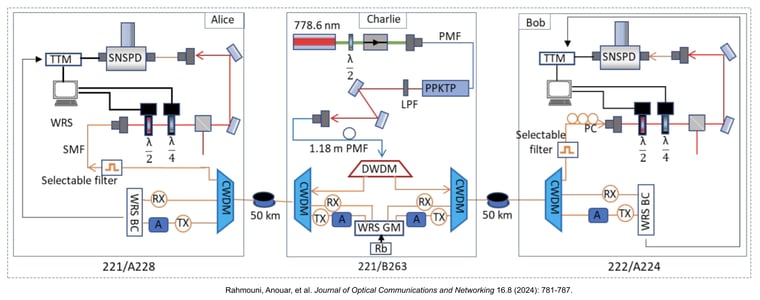
Pictured above is a rubidium clock at the source node (Charlie) being used to distribute 10 MHz clock reference using a classical optical signal to both the remote nodes (Alice and Bob). This uses White Rabbit timing references. White Rabbit is a timing protocol originally developed at CERN to deliver sub-nanosecond synchronization. The key idea is to distribute a stable clock reference (in this case, 10 MHz from a rubidium clock at the source) optically to remote endpoints and use it to align time tags. The classical reference used in this example shares the same fiber with the quantum signals, made possible by wavelength division multiplexing. Wavelength division multiplexing is a process whereby the two signals, classical and quantum, occupy different wavelength bands. This was tested across a distance of 100 km, using 50 km spools going from the source node to each of the two end nodes.
At the end nodes, the classical reference signal is used to time-tag photon detections, enabling precise coincidence measurements over long distances. In examples like this one, an important consideration is eliminating the crosstalk that can occur from the classical reference to the quantum signal. The classical signal wavelength is chosen to minimize the noise that pollutes the quantum signal.
An important advantage of sending the classical reference and quantum signals through the same fiber is that they experience nearly the same path-delay drift over time. As a result, tracking drift in the classical reference effectively tracks drift in the quantum channel as well, keeping the two end nodes synchronized. If the reference and quantum signals traveled on different fibers, mismatched drift between fibers could reduce synchronization accuracy.
Time-multiplexed sync pulses triggered by detections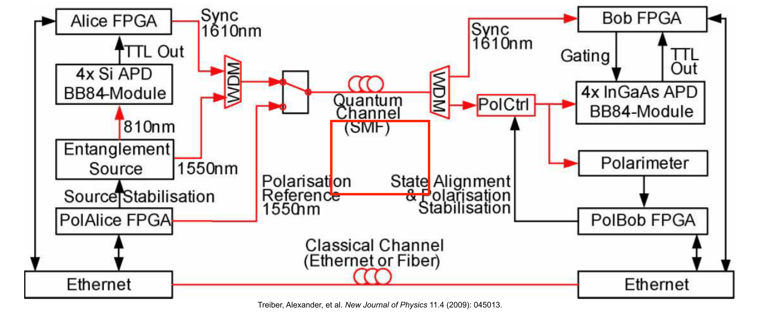
In the approach shown above, detection at one node triggers the generation of a classical optical pulse. That pulse is time-multiplexed with the quantum signal and travels through the same fiber to the other node. At the receiving node, the classical pulse that was sent from the first node is used to gate the detector – to open the detector for photon detections for precise time windows. Because these quantum and classical signals travel the same fiber length, this automatically accounts for the drift in the link. Since the detectors will be timed to be opened for accepting the photons, the coincidence detections will have accurate time tags.
GPS clocks as Global Time Reference.
In another example, pictured below, GPS clocks were used as global time reference. For long links using this method, fiber-introduced drifts will need to be accounted for. 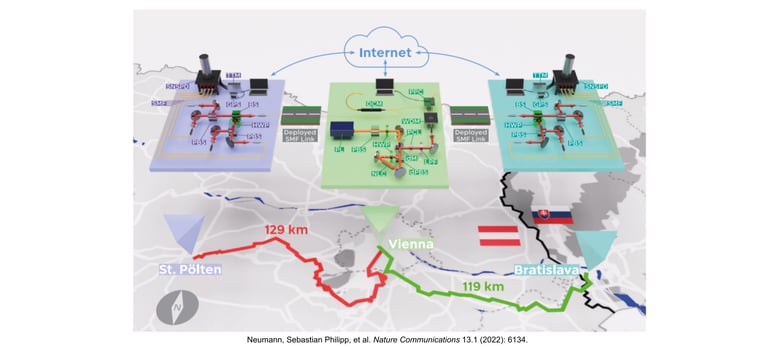
This demonstration linked two end nodes separated by 248 km (St. Pölten and Bratislava), with the entangled-photon source located in Vienna between them. To compensate for timing drift in the fiber links, the system continuously monitored entangled-photon coincidences and built a histogram of the detection-time differences between the two ends. The peak of this histogram reveals the current timing offset, which is then used to periodically correct the alignment of the nodes’ clocks (originally referenced to GPS) and track drift over time.
Each of these approaches to timing synchronization have unique benefits and tradeoffs depending on link loss and speed of link drifts. Choosing which particular approach is best for a given link depends on the link characteristics and the amount of downtime for drift compensation that can be tolerated in a chosen application.
Further Considerations for Timing Synchronization
Timing synchronization requirements are shaped by three primary factors: how the qubits are encoded (which degree of freedom is used) and what the network is trying to accomplish (the application), and how the link behaves over time (link dynamics).
1. Qubit encoding sets the baseline precision requirement
Different photonic encodings impose different timing tolerances.
- When qubits are frequency-encoded, the timing requirements can be especially strict. These systems may need to distribute radio-frequency reference signals in the tens of gigahertz to apply unitary gates, and the allowable timing jitter must be much smaller than a single RF cycle. In practice, that often translates to sub-picosecond synchronization precision, especially when working with tens-of-GHz qubit bandwidths to preserve high quantum-state fidelity.
- When qubits are polarization or time-bin encoded, synchronization is typically less strict, often ranging from nanoseconds down to a few picoseconds, depending on source bandwidth, detector jitter and the application.
The encoding scheme therefore sets the baseline precision target the synchronization system must meet.
2. Application sets the performance threshold
Beyond encoding, the intended application determines how much timing jitter can be tolerated.
For example:
- quantum sensing applications that measure photon time-of-flight differences may require picosecond-scale (or better) timing precision, achieved with low-jitter detectors, high-bandwidth sources, and tightly synchronized timing systems.
- In contrast, secure communication protocols using entangled photons can tolerate moderately relaxed timing constraints, provided the coincidence window remains sufficiently narrow to maintain a desired signal-to-noise-ratio.
3. Link characteristics determine the best strategy
The physical link itself influences which synchronization method is most practical:
- Fiber configuration
When a classical timing reference shares the same fiber as the quantum signal, both experience nearly identical delay changes. This makes drift correction more straightforward. If they use separate fibers, the delays can drift differently and may require additional compensation. - Photon rate and link loss
If enough correlated photon pairs reach the end nodes, the quantum signal itself can be used to extract timing offsets via coincidence histograms. However, at low photon rate or high loss due to long link distances, histogram-based updates become slow. - Drift speed
Fiber delay drift caused by temperature or environmental changes may occur slowly or rapidly. If drift is slow, periodic corrections using coincidence statistics may be sufficient. If drift is fast, a higher-power classical timing reference enables more frequent updates.
Choosing the Right Approach
Timing synchronization is ultimately an infrastructure choice shaped by encoding method, application needs, link distance, and environmental stability.
- If enough correlated photons arrive at both nodes and the link drifts slowly, the quantum signal itself can be used for synchronization. This reduces additional hardware needs for synchronization.
- If detections are sparse or the link drifts quickly, distributing a classical timing reference in the same fiber or (the same fiber bunch) enables faster and more stable timing updates.
Timing synchronization is not merely a technical detail, it is a foundational design choice in deployed quantum networks. Whether distributing a high-stability classical reference, leveraging time-multiplexed sync pulses, or extracting timing directly from coincidence statistics, the goal is the same: keep remote nodes aligned tightly enough to preserve high-fidelity correlations while minimizing accidental events. The right approach depends on link loss, drift dynamics, encoding method, and how quickly the system needs to recover from environmental changes. When matched correctly to the link and application, synchronization ensures that entanglement remains a usable and reliable resource for quantum secure communications, distributed sensing, and future quantum computing networks.