


 Twitter
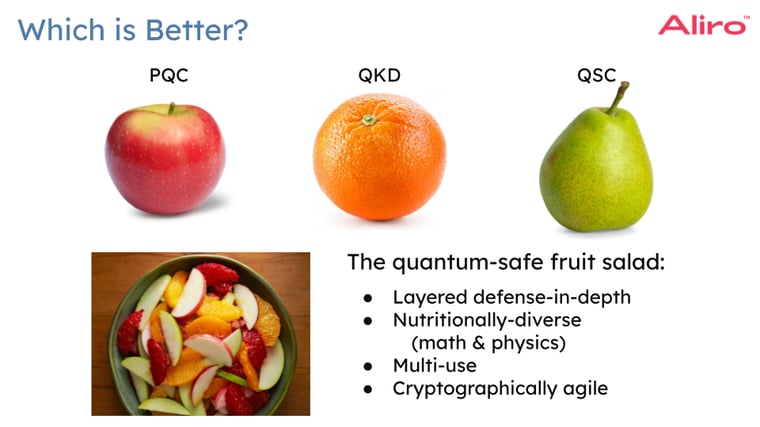
Just like a fruit salad mixes different fruits to balance taste and nutrition, a security architecture blends PQC, QKD, and QSC to cover a wider range of threats.
Cybersecurity can be broadly categorized into two types of security: theoretical security and implementation security.
- Theoretical security, or protocol security, is grounded in security against defined adversaries under specific assumptions: using certain mathematical frameworks, cryptographic protocols can be proven to be mathematically secure against specific known attacks by the adversary. For example, Quantum Secure Communication has been proven to be information-theoretically secure, meaning that even quantum computers cannot break it.
- Implementation security deals with how well these protocols perform in practice. Real-world deployments often introduce vulnerabilities due to hardware imperfections, operational oversights, or side-channel attacks – exploits that circumvent the theoretical model entirely.
QKD protocols have been proven to be theoretically secure against adversaries with quantum and classical capabilities. In practice, some implementations of these protocols have been shown to be vulnerable to side-channel attacks, where attackers exploit weaknesses in the hardware or software implementation rather than the underlying protocol. PQC algorithms are also designed to be theoretically resistant to quantum attacks, but might still be compromised by advances in algorithmic theory or by flaws in the implementation, such as electromagnetic interference or side-channel attacks.
Understanding attack profiles, the distinct types of vulnerabilities associated with these security methods, is important for preparing to use them effectively. Each of these technologies have different challenges and use cases, and no single method is a silver bullet for eternity. The attack profiles for PQC, QKD, and QSC will continue to change as advancements are made in quantum computing and cryptanalysis. For example, the advent of a powerful quantum computer running Shor’s algorithm would render RSA obsolete almost instantly. In comparison, PQC may hold up longer but could still be vulnerable to future computational breakthroughs.
No single technology can provide complete protection against all potential threats. Instead, a combination of PQC, QKD, and QSC can create an effective layered defense, where the strengths of each technology compensate for the weaknesses of the others. This approach provides flexibility, and ensures that organizations can adapt their security measures to the changes in technology.
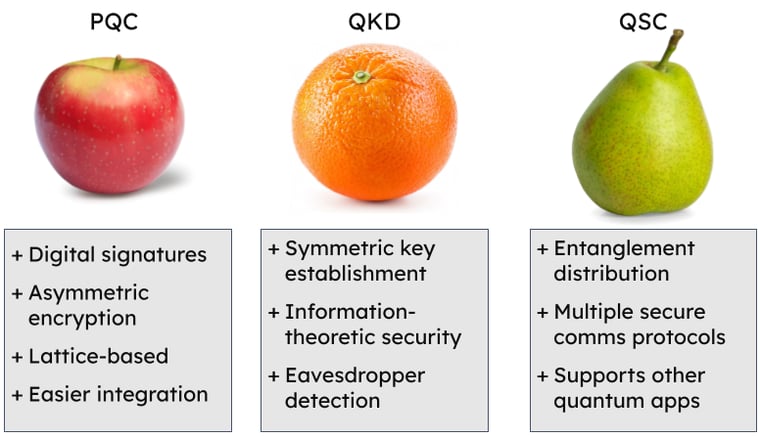
Some elements (like PQC) are practical and scalable; others (like QKD and QSC) offer stronger but more specialized protection. Together, they offer a more robust, future-proof solution than any one alone.
Hybrid Architectures: A Future-proof Cybersecurity Posture
The ideal future-proof approach to cybersecurity would provide:
- Layered defense-in-depth. Adversaries would need to simultaneously break multiple cryptographic systems and protocols to access any sensitive data.
- Math- and physics-based protections. PQC relies on computational complexity, while QKD and QSC offer protection based on the laws of physics.
- Versatility. This combination of technologies enables the creation of symmetric keys, use of digital signatures and certificates, and the ability to support applications beyond cybersecurity.
- Crypto agility. Organization can change which cryptographic algorithms are employed and proactively protect the network from attacks.
Integrating these solutions to harness their collective strengths is more robust, scalable, and responsive to the unknowns of tomorrow’s threat landscape. This integration occurs across multiple layers of the network architecture: the physical layer, the cryptographic layer, the network architecture layer, and the application layer. Each layer offers unique intersection points where quantum and classical technologies can complement each other to create a robust, future-proof security system.
Whether you're securing critical infrastructure, financial systems, or cloud environments, now is the time to build for what’s next.