


Use Cases and Industries
The possibilities of quantum networking
Applications and Use Cases
 Quantum Secure Communications
Protect sensitive communications without depending on assumptions about an adversary’s computational capabilities.
Quantum secure communication uses quantum physics to establish encryption keys between locations. With entanglement-based quantum key distribution (QKD), distant parties can generate shared secret key material while simultaneously checking for evidence of interference or eavesdropping.
Unlike conventional key establishment methods, the security of the quantum key exchange is based on physical principles rather than assumptions about the computational difficulty of solving mathematical problems.
Entanglement-based QKD can provide an independent source of key material for existing encryption systems, complementing post-quantum cryptography (PQC) and adding another layer to an organization's long-term security strategy.
For telecommunications providers, critical infrastructure operators, financial institutions, and government research programs, this creates opportunities to investigate and deploy new approaches to protecting high-value, critical communications.
For a comparison of QKD and QSC protocols, see our white paper, or check out Aliro’s software for QSC: AlirOS.
Space-Based Quantum Networking
Extending quantum connections beyond the reach of terrestrial networks.
As quantum networks expand, distance presents a significant challenge. Quantum signals traveling through optical fiber experience loss, limiting how far entanglement can be distributed without additional technologies.
Space-based quantum networking offers a way to overcome some of these limitations. By distributing entangled photons from satellites to ground stations, quantum connections can be established between locations separated by distances that are difficult to bridge through direct terrestrial links, including intercontinental links.
Unlike satellite-based QKD systems that require the satellite to be trusted with encryption keys, entanglement-based approaches allow ground stations to establish shared keys without the satellite ever possessing them. Looking further ahead, space-based entanglement distribution could also help connect regional quantum networks into larger, geographically distributed systems.
Satellite experiments have already demonstrated entanglement distribution and quantum key generation over long distances. Ongoing research and planned missions are advancing the technologies needed for more reliable space-to-ground quantum links and their integration with terrestrial quantum networks.
This white paper examines the design considerations and trade-offs of implementing quantum satellite systems that enable the long-range quantum communications links required for expanding the coverage of quantum networks.
Quantum Timing and Synchronization
New approaches to precise, resilient timekeeping across networks.
Precise timing and synchronization are essential to many modern systems, from telecommunications networks and electric grids to distributed sensing and scientific instrumentation. Even small differences between clocks can affect how these systems coordinate measurements, exchange information, and operate reliably.
Quantum networks offer another approach to synchronization. By measuring correlations between photons distributed across a network, researchers can determine timing differences between distant locations without relying on satellite-based timing signals. Entanglement-based techniques also offer opportunities to detect certain types of interference or manipulation affecting the timing exchange.
Experimental demonstrations have achieved highly precise synchronization using quantum correlations. Ongoing research is exploring how quantum timing techniques could complement existing systems, particularly where resilience, independent timing references, and the integrity of synchronization signals are important.
Connect with an Aliro expert to find out more.
 Quantum Position Verification
Verifying location as a new dimension of trust
In sensitive networks, the ability to verify that a system is operating from an authorized location could provide an additional layer of security beyond identity, a capability not fully addressed by conventional authentication.
Quantum position verification leverages quantum information and precisely timed communications to confirm a device's claimed physical location. By challenging a device to respond to quantum and classical signals within specific timing constraints, verifiers can test whether it is positioned where it claims to be. This approach could support new methods of authenticating fixed network endpoints, validating the locations of critical infrastructure devices, and protecting distributed systems against certain location-spoofing attacks.
Recent experiments have demonstrated quantum position verification over kilometer-scale optical links, marking progress toward practical implementations. Researchers continue to investigate how these techniques can scale to more complex network environments and provide security under realistic conditions.
See our white paper on QPV for a closer look at this application.
Multi-user Quantum Security
Secure connections beyond point-to-point, without relying on a trusted central source.
Entanglement-based quantum networks create new options for shared secure communications between multiple users, organizations, or locations. By distributing entangled photons from a shared source, these networks can enable different pairs of users to establish secret encryption keys, without requiring them to trust the source itself.
This approach opens the door to security services that extend beyond individual point-to-point connections. Researchers are exploring how quantum-generated keys can support secure group communications, shared secrets that require multiple parties to cooperate, and digital signatures for verifying the authenticity of information.
Multi-user entanglement-based networks have already been demonstrated experimentally, along with several of these security protocols. As the technology develops, these capabilities could support new approaches to secure communications across metropolitan networks, shared infrastructure, and organizations that need to exchange sensitive information.
Check out our blog on Quantum Secret Sharing for closer examination of this application.

Networked Quantum Sensing
Connecting quantum sensors to create new types of precision measurement.
Quantum sensors use properties of quantum systems to measure physical quantities such as magnetic fields, temperature, and changes in optical phase. Connecting these sensors through quantum networks creates opportunities to investigate measurements that extend beyond the capabilities of individual devices.
By distributing entanglement between sensing locations, researchers can coordinate measurements across multiple sensors and improve sensitivity to certain physical phenomena. These techniques could support applications ranging from distributed environmental measurements to advanced scientific instruments and astronomical observations. One particularly promising application is long-baseline optical interferometry, which could allow telescopes separated by great distances to work together without requiring faint starlight to be physically transported between them. This approach could enable astronomical observations with significantly greater resolution than conventional optical telescope arrays.
Experimental research has demonstrated improvements in measurement sensitivity using entangled sensors, including early demonstrations across optical fiber links. While the benefits depend on the measurement being performed and the quality of the distributed entanglement, continued advances in quantum networking could enable increasingly sophisticated sensing systems operating across multiple locations.
Our blog on quantum sensing and metrology has more details.
 Distributed Quantum Computing
Interconnecting quantum processors to extend quantum computing power.
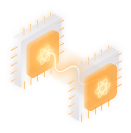
Building more powerful quantum computers requires overcoming significant challenges in scaling individual processors. Distributed quantum computing offers another approach: connecting multiple quantum processors so they can work together as part of a larger computational system.
By distributing entanglement between processors, quantum networks can enable operations that link qubits in separate devices. This creates possibilities for modular quantum computing architectures, where computational resources can be expanded by connecting processors rather than relying entirely on increasingly large individual systems.
Researchers have already demonstrated quantum operations between separate processors using entanglement, establishing important building blocks for distributed quantum computing. As quantum interconnects, memories, and network technologies advance, these approaches could help enable larger, more flexible quantum computing systems.
Explore scaling quantum computation using quantum networks on our blog.
Industries and Verticals
Government and National Laboratories
Government research programs and national laboratories are helping establish the foundations of future quantum networks. Their work spans entanglement distribution, quantum memories and repeaters, network architectures, the development of new quantum communication protocols, and more.
As experimental networks become more sophisticated, researchers are investigating how entanglement can support applications beyond secure key distribution, including distributed quantum computing, networked sensing, precise timing, and new approaches to authentication.
These efforts are expanding our understanding of what quantum networks can achieve while advancing the technologies and architectures needed to move from individual experiments toward increasingly capable, interconnected quantum systems.
Aerospace and Defense
Aerospace and defense organizations are investigating how quantum networking could enable new capabilities across terrestrial, airborne, and space-based systems.
Satellite-based entanglement distribution offers a potential path toward quantum communications over distances that are difficult to achieve through terrestrial fiber networks. At the same time, research into quantum timing, position verification, and networked sensing is exploring new approaches to coordinating distributed systems, authenticating the locations of critical assets, and operating in environments where conventional timing and positioning signals may be disrupted.
From experimental ground networks to future space missions, these efforts are advancing the technologies needed to investigate how quantum resources could support increasingly complex and geographically distributed systems.
Financial Institutions
Financial institutions depend on secure communications, precise synchronization, and reliable infrastructure to support trading, transactions, and the exchange of sensitive information. Quantum networking offers opportunities to investigate new approaches to each of these requirements.
Entanglement-based quantum key distribution can provide an independent source of encryption key material for communications between data centers and other critical facilities, complementing existing cryptography and post-quantum security strategies.
Quantum timing and synchronization techniques are also being explored for applications where accurate, reliable timekeeping is essential, including financial exchanges and high-frequency trading. By using correlations between quantum particles, these approaches could provide additional ways to establish timing relationships and investigate the integrity of synchronization signals.
Looking further ahead, quantum position verification could introduce new methods for verifying the physical locations of trading systems, network endpoints, and other sensitive infrastructure. Together, these emerging capabilities offer financial institutions opportunities to explore new dimensions of security, timing resilience, and trust across distributed systems.
Utilities and Critical Infrastructure
Utilities and critical infrastructure operators depend on reliable communications and precise synchronization to coordinate systems across substations, control centers, and other geographically distributed facilities. As these networks evolve, protecting sensitive information and maintaining operational resilience remain essential priorities.
Quantum networking creates opportunities to investigate additional approaches to securing communications across critical infrastructure. Entanglement-based quantum key distribution can provide an independent source of encryption key material, complementing existing cryptography and post-quantum security strategies while supporting research into protecting communications between critical facilities.
Quantum timing and synchronization also offer promising areas of investigation, particularly for systems that depend on accurate coordination across multiple locations. By using quantum correlations to establish timing relationships, researchers are exploring techniques that could provide additional ways to maintain synchronization and detect certain forms of interference.
Together, these developments offer opportunities to investigate how quantum networking could contribute to the long-term security and resilience of essential infrastructure.
Telecommunications and Network Providers
Telecommunications providers are uniquely positioned to help bring quantum networking beyond research environments and into existing communications infrastructure. Their extensive fiber networks, operational expertise, and experience delivering services across multiple locations provide a foundation for exploring new quantum-enabled capabilities.
Entanglement-based quantum key distribution creates opportunities to offer additional security services alongside existing encryption and post-quantum cryptography. As quantum networking technologies advance, multi-user entanglement distribution could support new approaches to secure communications across metropolitan networks, including services that allow customers to establish shared keys without trusting the network provider with those keys.
For telecommunications and network operators, these developments create opportunities to evaluate new service models, investigate how quantum technologies coexist with classical network traffic, and prepare infrastructure for future applications that depend on distributed entanglement.
Quantum Computing
Scaling quantum computers presents significant challenges, from maintaining qubit fidelity to managing the complexity of increasingly large processors. Quantum networking offers another approach: connecting multiple quantum processors so they can operate together as a larger computational system.
By distributing entanglement between processors, quantum networks can enable operations across separate devices, creating opportunities for modular architectures that expand computational capabilities without relying entirely on larger individual processors.
Early demonstrations have shown that quantum operations can be performed between separate processing modules. As quantum interconnects, memories, and entanglement distribution technologies advance, these approaches could play an important role in developing scalable, interconnected quantum computing systems.
Data Centers and Cloud Infrastructure
Data centers and cloud infrastructure providers manage the movement of sensitive information across facilities, networks, and organizations. As security requirements evolve, quantum networking offers opportunities to introduce additional approaches to protecting these communications.
Entanglement-based quantum key distribution can provide an independent source of encryption key material that complements existing cryptography and post-quantum security strategies. For data center operators, this creates opportunities to investigate quantum-secured connections between facilities without replacing established encryption infrastructure.
Looking ahead, multi-user entanglement-based networks could enable new security services for customers sharing cloud and colocation infrastructure. By allowing users to establish shared keys without requiring them to trust the network provider with those keys, these technologies could introduce new models for secure communications across interconnected environments.
Quantum Hardware Developers
Developing the technologies that make quantum networking possible requires more than demonstrating the performance of individual devices. As quantum networks evolve, the ability of different components to work together becomes increasingly important.
For developers of quantum light sources, detectors, memories, repeaters, and photonic technologies, quantum networking creates opportunities to investigate how their components perform within larger systems. Factors such as transmission loss, timing, fidelity, and interactions between devices can significantly influence the capabilities of an entire network.
Research into entanglement distribution, quantum repeaters, and emerging network architectures is creating new opportunities to demonstrate technical capabilities, explore interoperability between different technologies, and develop components that can support increasingly sophisticated quantum networks.